
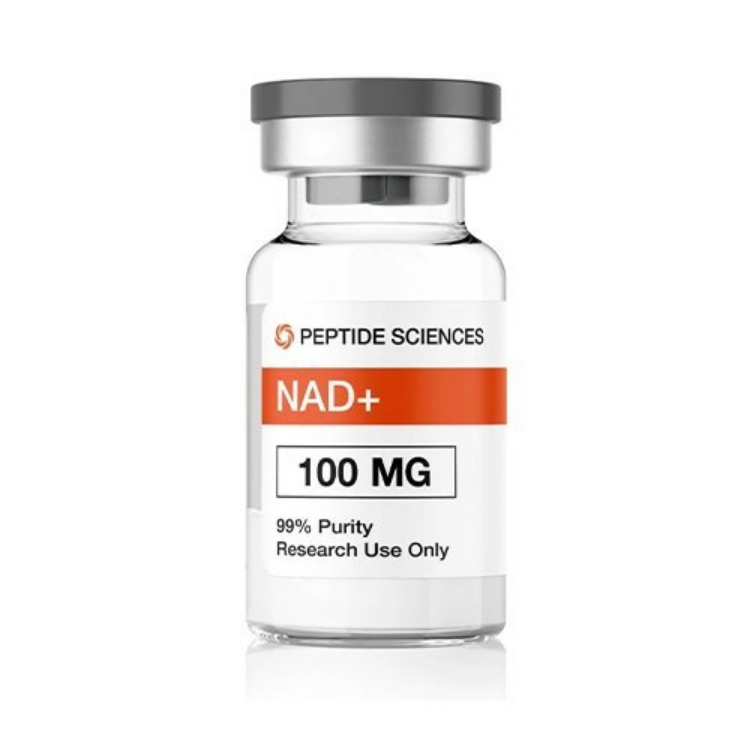
NAD+ Peptides
£66.00
NAD⁺Peptides
First, a small correction in terminology: NAD⁺ is not a peptide. It is a coenzyme found in all living cells, central to energy metabolism and cellular repair. It is sometimes grouped informally with “peptides” in wellness or research discussions, but chemically and biologically it is fundamentally different.
Nicotinamide adenine dinucleotide (NAD⁺) plays a critical role in mitochondrial energy production, DNA repair, and cellular signaling. Interest in NAD⁺ has grown significantly in aging biology and metabolic research due to its connection with cellular energy decline over time. Closely related compounds often discussed alongside NAD⁺ include:
- Nicotinamide mononucleotide (NMN)
- Nicotinamide riboside (NR)
These are NAD⁺ precursors, meaning the body can convert them into NAD⁺ through metabolic pathways.
Biological Role of NAD⁺
NAD⁺ is essential for:
- Cellular energy production (ATP synthesis via mitochondria)
- DNA repair mechanisms
- Regulation of circadian rhythms
- Activation of sirtuins (longevity-related enzymes)
- Redox balance (electron transfer in metabolism)
As NAD⁺ levels decline with age, research has linked this reduction to decreased mitochondrial efficiency, reduced cellular repair capacity, and metabolic slowdown.
Mechanism in Research Context
NAD⁺ and its precursors are studied for their ability to:
- Restore intracellular NAD⁺ levels
- Support mitochondrial oxidative metabolism
- Enhance activity of sirtuin enzymes (SIRT1–SIRT7)
- Improve cellular stress resistance
- Support DNA repair pathways (PARP enzymes)
Rather than acting like signaling peptides, NAD⁺ functions as a metabolic regulator and enzyme cofactor.
Key Features (Research Perspective)
- Cellular Energy Core Molecule – Central to ATP production and mitochondrial function
- DNA Repair Support – Involved in activation of repair enzymes
- Metabolic Regulation – Influences glucose, lipid, and energy pathways
- Aging Biology Interest – Studied extensively in age-related decline models
- Precursor-Based Supplementation Research – NMN and NR studied as NAD⁺ boosters
Research Applications
NAD⁺ and its precursors are studied in areas including:
- Aging and longevity biology
- Mitochondrial dysfunction
- Neurodegenerative disease models
- Metabolic syndrome and insulin sensitivity research
- Cardiovascular function studies
- Exercise recovery and endurance metabolism
- DNA damage and cellular stress response
Product / Research Specifications (Typical in Studies)
- Name: NAD⁺ (Nicotinamide adenine dinucleotide)
- Type: Endogenous coenzyme (not a peptide)
- Form in research: NAD⁺, NMN, NR compounds
- Appearance: Varies (powder or injectable research formulations in lab settings)
- Storage: Typically refrigerated or frozen depending on formulation
- Use: Research use only in most non-clinical contexts
Benefits Being Investigated
Current research suggests NAD⁺ restoration may potentially:
- Support mitochondrial energy production
- Improve cellular repair efficiency
- Enhance metabolic function
- Support healthy aging pathways
- Improve cellular resilience under stress
- Support neuroprotective mechanisms in preclinical models
Important Context
Unlike signaling peptides such as Follistatin or SS-31, NAD⁺ is a core metabolic molecule required for life, not a targeted receptor-binding peptide.
Most “NAD⁺ therapy” concepts in modern research are actually focused on raising NAD⁺ levels indirectly using precursors like NMN or NR, since NAD⁺ itself has limited stability and bioavailability in many delivery contexts.
Research in this area is still evolving, especially regarding long-term human outcomes, optimal dosing strategies, and comparative effectiveness between different NAD⁺-boosting approaches.
Be the first to review “NAD+ Peptides”
Related products
weight Loss & Fat Burners
weight Loss & Fat Burners
weight Loss & Fat Burners
weight Loss & Fat Burners
weight Loss & Fat Burners
weight Loss & Fat Burners
weight Loss & Fat Burners
weight Loss & Fat Burners
Reviews
There are no reviews yet.